
The Critical Nature of Pollination
One of the many problems within our current environmental crisis is how insects and plants are affected by such issues as pollution and land loss. According to the UK Centre for Ecology & Hydrology, “Air pollution dramatically reduces pollination because it degrades the scent of flowers, affecting bees’ ability to find them.” Furthermore, according to Dr Ben Langford, “Some 75% of our food crops and nearly 90% of wild flowering plants depend, to some extent, upon animal pollination, particularly by insects.” Hence, it’s critical that we prioritise preserving all insects, including bees. Indeed, everything relies on everything else to survive. Humans are no different. If we don’t harmonise with nature, we won’t survive. We have nowhere else to go, so we must take care of our only home.
Which creatures pollinate flowers?
According to Earthwatch: Europe, pollinators include bumblebees, honeybees, solitary bees, wasps, hoverflies, other flies, beetles, small insects, butterflies, and moths. Although, there are other pollinators such as bats and the wind. Apparently, flies are the most important pollinators after bees, which is astonishing. Flies don’t tend to be appreciated, but everything has a place in nature and is alive equally. According to the Natural History Museum, “… at least 1,500 insect species pollinate plants in the UK. In some parts of the world, birds, bats and even lizards also get involved.” Insects have been pollinating flowers for at least 99 million years, as noted by the Natural History Museum. While not all plants rely on animals for pollination, many do, having evolved a close relationship that is currently under threat.
Are bees the most important pollinators?
The Scottish Bee Company notes that it isn’t a matter of saying, “Yes, the honeybee is the best pollinator by far.” (To be sure, that isn’t a quote.) It’s complicated. There are many species that pollinate plants requiring help with pollination. It’s accepted that bees are important, and the honeybee is the most efficient pollinator, but all insects and other creatures are imperative to the overall ecosystem, such system being an environment relying on a mixture of life and processes to effectively sustain it. If one creature ceases to exist, that has an impact on other life forms. If a plant depends on a certain insect to continue living, and vice versa, one cannot exist without the other. Of course, countless species have gone extinct throughout history, and those that did not, adapted and evolved to survive. But what happens if the consequences of one or more creatures dying out are too great? In the case of pollination, it’s a critical natural process. What would happen if there was no pollination, or if there wasn’t enough?
A world without pollination
According to the US Forest Service, “Without pollinators, the human race and all of Earth’s terrestrial ecosystems would not survive.” That’s how reliant we are on pollination. Unfortunately, it’s like when someone has a habit such as smoking cigarettes. They know, these days, that it’s bad for their health, yet, speaking from the perspective of having seen it happen, it may take heart problems, for example, to instil the fear that inspires them to stop smoking. When you don’t see immediate effects, there is a natural tendency to ignore the problem as if it isn’t a real issue. Why must it take immediate danger to create a sense of urgency? Isn’t it better to prevent the hazard in the first place?
What can we do to help?
The US Forest Service says, “Native plants are adapted to the local climate and soil conditions where they naturally occur.” Native pollinators particularly enjoy native plants. According to the Natural History Museum, “Insect pollinator species are in decline as biodiversity loss around the planet accelerates.” Climate change, agriculture and the use of pesticides, and habitat loss are just some of the causes of the reduction in biodiversity. In fact, it is believed that we are living during the sixth mass extinction event. Such event is defined as “… a short period of geological time in which a high percentage of biodiversity, or distinct species – bacteria, fungi, plants, mammals, birds, reptiles, amphibians, fish, invertebrates – dies out,” according to the World Wildlife Fund. Such period, however, can range from thousands to millions of years. It depends on what the cause is as to the speed of extinction. It should be a shocking fact that we are in an extinction event. Or is that not enough to kick us into gear to take significant global action to mitigate the problems?
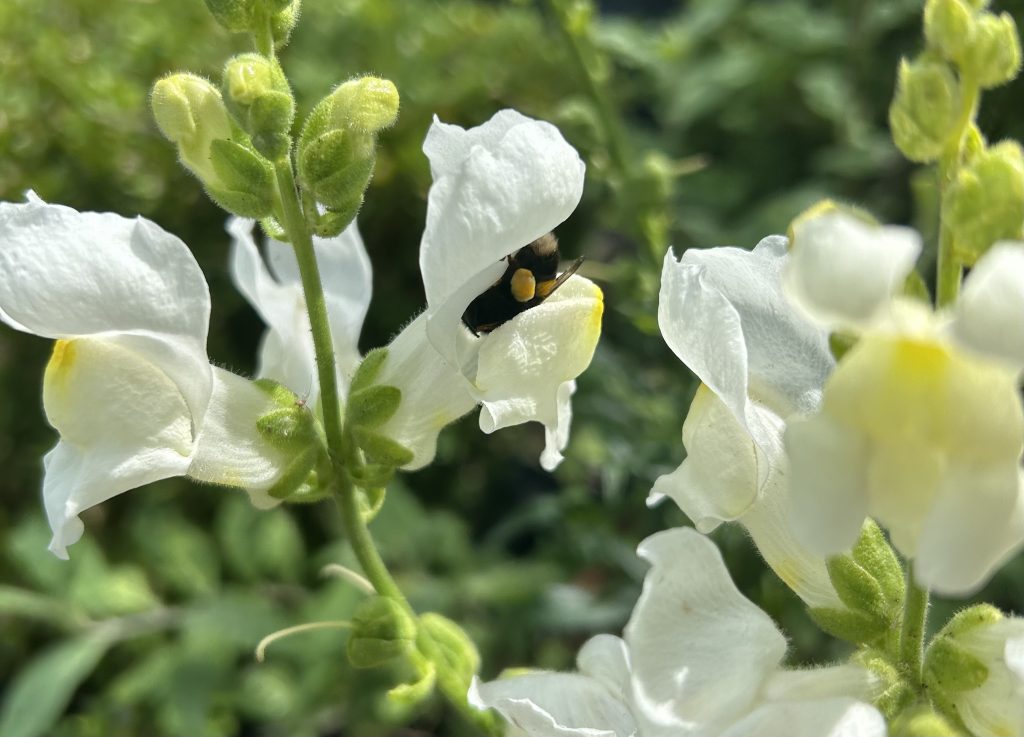
A bumblebee getting nectar from inside a flower.
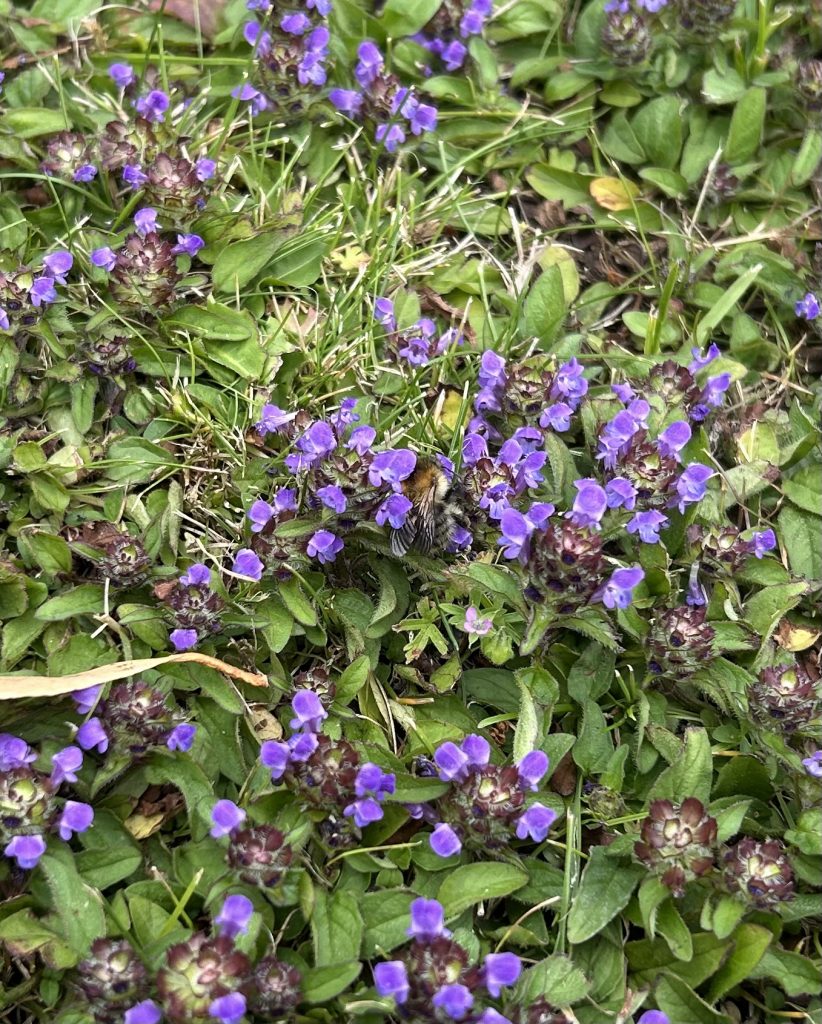
A bumblebee collecting nectar from wildflowers on the lawn.
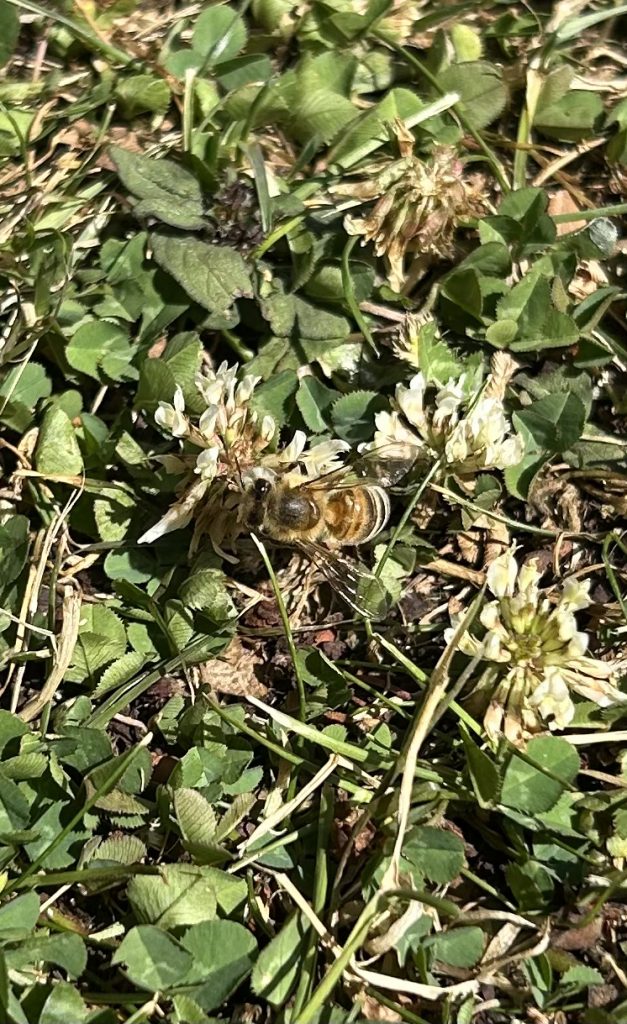
A honeybee gathering nectar from wildflowers on the lawn.
The Natural History Museum says that growing wildflowers, allowing your lawn or part of your lawn to grow wilder rather than just mowing it entirely, and building a bee hotel are three great ways to help insect pollinator populations. The author noticed that the wildflowers growing amongst the grass of the lawn attract a lot of honeybees and bumblebees, which is such a peaceful, pleasant phenomenon to see. Mowing them down, thereby removing them, takes a food supply from the bees. Harmony with nature is vital, like the reliance of plants on carbon dioxide, and their subsequent production of oxygen that we desperately need. Sustain nature, and nature will sustain you.