
The Invention of Plastic
The origin and growth of plastic
According to the Science History Institute, “The first synthetic polymer was invented in 1869 by John Wesley Hyatt, who was inspired by a New York firm’s offer of $10,000 for anyone who could provide a substitute for ivory.” Ironically, that resulted in some protection of the natural world, with respect to elephants and other creatures. Although, people did not stop poaching altogether, and hunting remains a problem.
Following this, “In 1907 Leo Baekeland invented Bakelite, the first fully synthetic plastic, meaning it contained no molecules found in nature.” Furthermore, “World War II necessitated a great expansion of the plastics industry in the United States. … Nylon, invented by Wallace Carothers in 1935 as a synthetic silk, was used during the war for parachutes, ropes, body armor, helmet liners, and more.”
However, after World War II, perceptions began to change as people started to see the impacts of the use of plastic. “Plastic debris in the oceans was first observed in the 1960s.” Fast-forward, and this traditionally fossil-fuel-based creation is in our water supply, the air we breathe, and the food we eat, albeit not in every instance. We have to filter our water, which means there’s an argument for filtering our air (the age of gas masks?), and we have to consider where our food has come from and therefore whether it potentially contains microplastic.
A comparison with human history
In little over 150 years, people have caused severe planetary damage; not a long time when compared with all of human history. According to Britannica, Homo sapiens evolved in Africa around 315,000 years ago, “… but there is abundant fossil evidence to indicate that we were preceded for millions of years by other hominins.” Furthermore, “… the trove of fossils from Africa and Eurasia indicates that, unlike today, more than one species of our family has lived at the same time for most of human history.” Hence, we have caused mass destruction in a very short space of time, when compared with our history.
What’s being done to solve the problem?
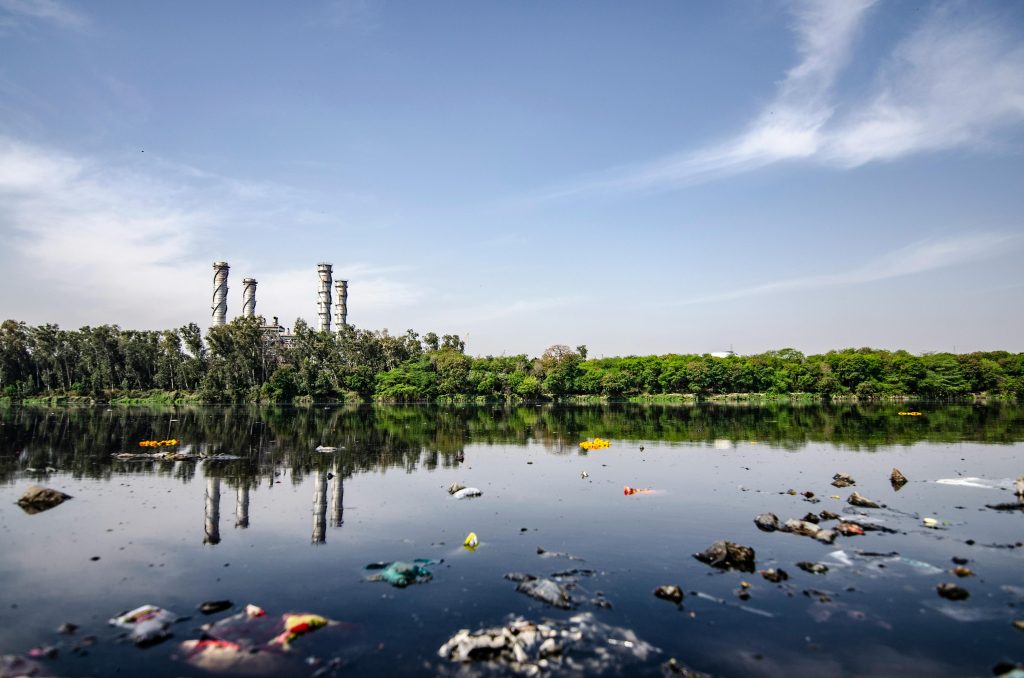
The problems caused by our use of plastic are a global issue. Evidently, the discovery of plastic pollution is nothing new, but awareness and solutions have significantly increased in more recent times.
The Seabin Foundation collects rubbish in the sea with floating Seabins that are installed in marinas, ports, and yacht clubs.
“The Ocean Cleanup is a non-profit organization developing and scaling technologies to rid the oceans of plastic.” They say that they “… aim to clean up 90% of floating ocean plastic pollution by 2040.”
According to Novonesis, “once a plastic product is recycled, the plastic loses its quality. Also, fresh plastic has to be added to the recycled plastic to create new products out of it.” But, in 2016, Japanese researchers discovered an enzyme, Ideonella sakaiensis, that eats plastic.
With innovations like these, we can overcome the plastic problem, although we also need to reduce our use of plastic and change the materials used for packaging – something that is being done, albeit gradually. The crisis should be taken far more seriously by all politicians, and laws should be strict with a sense of urgency, like during the COVID-19 pandemic. Yet, we find ourselves now heading towards COP30 (the UN Climate Change Conference: Conference of the Parties) – that’s 30 years of slow progress to fight one of the most dire issues of our time and perhaps even of human history. Perhaps technology and science, developed privately, offer more of the answer than politics.